CreatorFi

Introduction
CreatorFi provides advances to YouTube creators, music artists and labels, and gaming studios against revenue they've already earned. No equity, no ownership change, no personal or corporate guarantee. As Chief Design Officer, we own the design function end to end, from the creator-facing funding product to the internal admin platform the underwriting and risk teams run the business on every day, alongside the product decisions, roadmap, and delivery timeline behind both. This case study covers both.

Process
Turning an Advance Application Into Five Steps
Creator financing has a reputation problem: pitch decks, long applications, weeks of waiting. We collapsed the entire funding process into five steps, connect or upload earnings (a YouTube account or royalty statements), automatic revenue analysis, a transparent offer, funds landing in a bank account or stablecoin wallet, then automatic repayment tied to future earnings. Each vertical (YouTube creators, music artists and labels, gaming studios) gets the same five-step shape, with the underlying data source and underwriting logic swapped out underneath.
Designing One Flow for Three Very Different Businesses
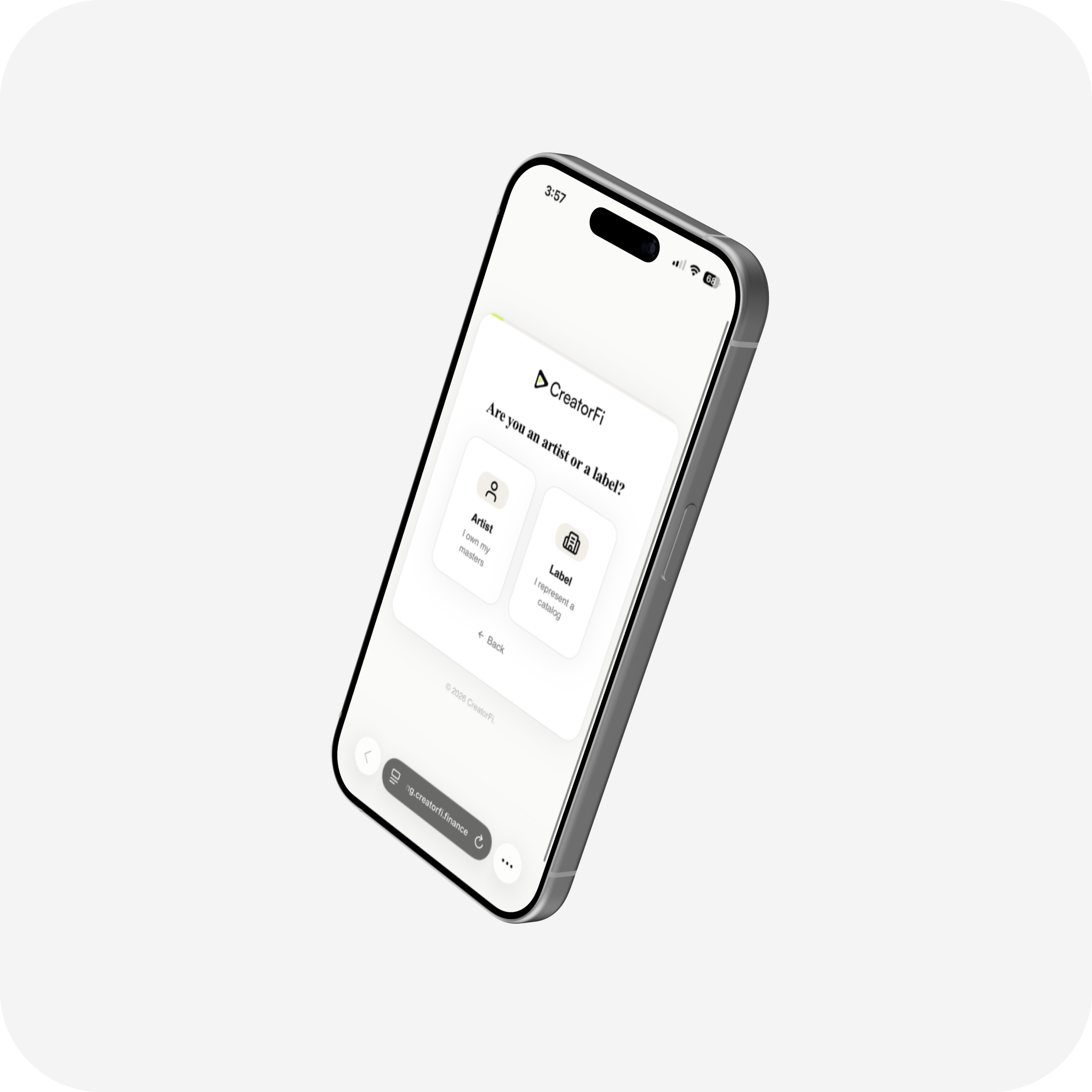
A solo YouTube creator, a record label with a multi-artist catalog, and a mobile gaming studio have almost nothing in common operationally, but the product needed to feel like one coherent thing, not three bolted-together tools. Each vertical page keeps the same five-step structure and the same core promise (non-dilutive capital against real revenue) while swapping the specifics that actually matter to that audience: AdSense thresholds and channel health for creators, DSP statement formats and catalog ownership percentage for music, and revenue diversification and asset-level underwriting for gaming studios.
Making Risk Legible Without Hiding the Reasoning
CreatorFi's advances are backed only by future revenue. So underwriting's real job after funding is catching revenue deterioration before it becomes a missed payment. By the time a payment is missed, the window to intervene is already gone. The risk-monitoring system exists to keep that window open: daily and monthly signal on revenue trends, payment integrity, and covenant compliance across the book, early enough to act.
An opaque risk score would erode underwriter trust, not build it. They needed the reasoning, not just a number, since acting on an unexplained signal has a real cost: wasted outreach to a healthy borrower, or a missed signal on one who actually needed attention. So the rule was strict: no alert surfaces without a plain-language explanation before any raw threshold or technical detail.
Alerts on a loan group into a case, computed live rather than stored, so there's never a stale status in front of an underwriter making a decision. Severity is binary, Red or Yellow, because a team triaging a full book daily needs today versus later, not six gradations. The top alert is always labeled "Priority Alert" with a "selected because..." explainer, a mechanical sort, not a judgment call, so the underwriter's judgment stays final. A technical detail drawer sits one click away: collapsed by default, never required reading.
Making Sure Nothing Gets Approved on Bad Data
Every dollar on the book repays automatically as a percentage of incoming revenue, so the credit team's view of portfolio health is only as accurate as the servicing data behind it. A statement missing data or unreconciled means covenant checks, escalations, and reporting are running on numbers nobody can trust yet. Every active deal generates a recurring statement that has to clear review before publishing. The queue runs on three statuses, Missing data, Awaiting approval, Published, so an admin always knows exactly what's blocking trust in a given number. Bulk approval only covers eligible statements; anything missing data is excluded entirely, so a gap can never get rubber-stamped through.
.png)


Conclusion
The platform has onboarded 20+ enterprise businesses and is actively servicing multi-million dollars in funding across the active book.
